
Purpose
Stories shape the way we see the world and each other. In a time when Islamophobia continues to rise, fueled by media-driven stereotypes that paint Muslims as aggressors or extremists, the need for authentic representation has never been more urgent. The Muslim world is rich with narratives of courage, compassion, and moral integrity—stories that remain untold or misunderstood in mainstream media.
This guide seeks to empower content creators to fill that void by presenting a framework for the Muslim Hero’s Journey. While it is easy enough to depict a heroic character who happens to be Muslim, standing for values aligned with a universal concept of “good,” what is far more impactful are heroes driven to do good because of their faith. This is the difference that this model aims to highlight: how Islamic values and principles shape the hero’s motivations and actions.
Islamic ethics often align with universal ideals, such as justice, mercy, and humility. However, Islam also offers a distinctive vision of what it means to live a good life. By focusing on the particular values and actions that Islam prescribes as “good”—especially where they may diverge from universal concepts—this guide helps creators craft stories that are not only resonant but deeply authentic to the Muslim worldview.
It’s important to emphasize that this model is not intended to be exhaustive. It outlines one possible journey from beginning to end, identifying key stages and archetypes along the way. There are countless other journeys a Muslim hero might take, and other archetypes that could emerge, depending on the context and the challenges they face. This guide represents a starting point, a foundation for exploring how faith transforms ordinary individuals into extraordinary heroes.
In future editions, we hope to expand on this foundation, incorporating new perspectives and voices to enrich the narrative possibilities available to creators. For now, let this model serve as an invitation: to tell stories that challenge stereotypes, inspire audiences, and illuminate the power of faith as a force for good in the world. At the very least, we intend for the archetypes we present here to serve as building blocks for content creators to work with, which means that you are free to pick and choose which ones to use and how to arrange them.
Audience
This guide is designed for storytellers of all kinds—authors, screenwriters, game developers, and any creator seeking to craft compelling narratives with authentic Muslim representation. It is particularly relevant for those who recognize the immense potential of stories to educate, inspire, and transform perspectives.
For Muslim creators, this guide offers a framework to reflect their own values and experiences in their work. It equips them with the tools to portray heroes whose faith is not incidental but integral to their journey. By emphasizing the unique virtues and challenges shaped by Islamic principles, Muslim storytellers can create narratives that resonate deeply with their own communities while also engaging a broader audience and presenting them with a new perspective.
For non-Muslim creators, this guide provides insight into the richness of Islamic ethics and the nuanced ways faith can shape a hero’s actions and motivations. By understanding these principles, they can portray Muslim characters with the respect and authenticity they deserve, countering stereotypes and fostering greater understanding.
In a world where representation matters, this guide serves as a bridge between cultures. It invites all creators to tell stories that transcend superficial depictions and explore the profound role faith plays in shaping the human experience. Whether you’re creating for a global audience or a niche community, this model aims to help you craft characters and narratives that are authentic, relatable, and unforgettable.
Structure
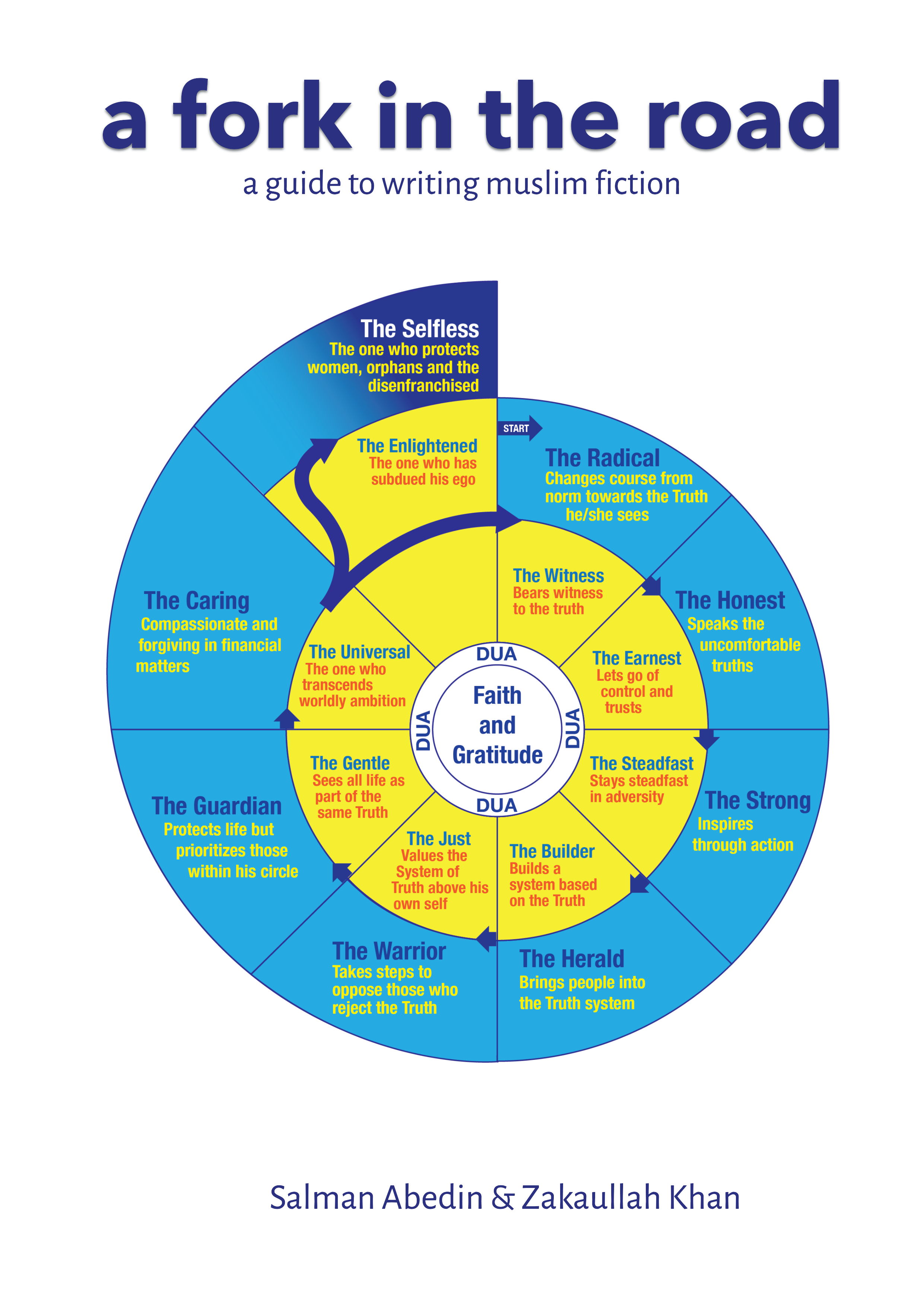
The Muslim Hero’s Journey is built on eight interconnected stages, each reflecting a specific evolution of the hero’s character and role in the world. These stages capture both the outward actions (External) and the inward motivations (Internal) of the hero. Together, they chart a path of personal growth, moral integrity, and service to humanity, all deeply rooted in Islamic principles.
Two overarching elements guide this journey:
- Dua (Supplication) as a Catalyst
At every step, the hero is propelled forward by Dua. Whether spoken aloud or felt as a silent yearning, Dua serves as the bridge between human effort and divine guidance. It is this supplication that transforms moments of struggle into opportunities for growth and steers the hero toward their next evolution. - An Unshakable Core of Faith and Gratitude
Faith underpins every step, binding the hero’s journey together. It is the unwavering trust in the Creator’s plan and the gratitude that springs from this trust. Faith begins as a seed in the hero’s heart and blossoms as they progress, grounding their actions in truth and righteousness.
The eight stages of the journey unfold as follows:
- The Radical / The Witness
The hero stands apart, bearing witness to a newfound truth and rejecting the status quo. - The Honest / The Earnest
They embrace vulnerability, speaking uncomfortable truths with courage and sincerity. - The Strong / The Steadfast
The hero becomes a source of inspiration through their resilience and unwavering commitment to the truth. - The Herald / The Builder
They begin creating systems and inviting others to join them, transforming their vision into reality. - The Warrior / The Just
The hero defends the truth, prioritizing justice over personal gain, even when it requires difficult decisions. - The Guardian / The Gentle
They act as protectors, balancing strength with compassion, and upholding the interconnectedness of life. - The Caring / The Universal
The hero transcends worldly ambition, showing compassion and forgiveness in their dealings with others.
At this point, he/she either begins a new cycle of discovery, which returns them to step 1, but at a higher level of awareness, or they move on to step 8, which concludes their journey.
- The Selfless / The Enlightened
At the pinnacle of the journey, they embody humility and service, becoming a guide and protector for society’s most vulnerable.
These stages are not a linear progression but a cyclical process, mirroring the continuous growth of the soul. Each step is an evolution, bringing the hero closer to their Creator and their ultimate purpose. This is not to suggest that the protagonist improves at a steady rate. He might progress by fits and starts. He might waver and fall back at times as well. After all, “to err is human” as the saying goes. More often than not, it is the doubts and the mistakes that make the journey meaningful and relatable for the audience.
A Discussion on Character Flaws and Weaknesses in Light of Islam
In contemporary storytelling, particularly in fantasy and modern fiction, there is a growing trend to emphasize the flaws and weaknesses of protagonists. On the surface, this approach serves to humanize characters, making them relatable and accessible to audiences. A protagonist who struggles, doubts, or falters is easier to connect with than one who seems flawless and invincible. However, this trend has increasingly crossed into dangerous territory: the glorification of sin and the normalization of immoral behavior.
From an Islamic perspective, character flaws should not be romanticized or celebrated. Islam acknowledges human fallibility and a Muslim protagonist does not need to be flawless, but we have to be careful to show their human flaws or occasional mistakes as what they are: mistakes. We do not condone or try to justify actions or traits that contradict moral principles.
While portraying a character’s struggle with flaws is a valid and often powerful storytelling device, such flaws must be shown in their true light—as challenges to overcome, not as virtues to be admired.
The Hadith of the Seven Destructive Sins, narrated by Abu Huraira, serves as a poignant reminder of actions that are deeply harmful and must be avoided:
The Prophet (ﷺ) said, “Avoid the seven great destructive sins.” The people enquired, “O Allah’s Messenger (ﷺ)! What are they?” He said, “To join others in worship along with Allah, to practice sorcery, to kill the life which Allah has forbidden except for a just cause, (according to Islamic law), to eat up Riba (usury), to eat up an orphan’s wealth, to give back to the enemy and fleeing from the battlefield at the time of fighting, and to accuse chaste women, who never even think of anything touching chastity and are good believers.”
(Sahih al-Bukhari 2766)
This Hadith highlights behaviors that are not only sins but are also destructive to individuals and society. When creating stories inspired by the Muslim journey, care must be taken to ensure that such actions are not glorified, even if they serve as part of a character’s journey.
Striking a Balance in Storytelling
- Humanizing Without Glorifying
Protagonists can — and should — have flaws. However, these flaws must be portrayed as challenges to be addressed or obstacles to overcome, not as admirable traits. For instance, a character’s pride can be shown as a source of internal struggle, ultimately leading to their growth through humility, rather than being presented as a justification for arrogance. - Portraying Repentance and Growth
A hallmark of Islamic storytelling is the emphasis on repentance and transformation (which is what this entire journey is about). Characters can make mistakes, but their journey should include a sincere effort to rectify those mistakes and seek forgiveness. This aligns with the Quranic emphasis on Allah’s mercy and the value of turning back to Him. - Avoiding the Glorification of Sin
Sinful actions — whether greed, dishonesty, or betrayal — can be part of a narrative, but they should never be celebrated. Instead, the story should focus on the consequences of these actions and the character’s eventual realization of their error.
The Role of Content Creators
As content creators, the responsibility lies in crafting narratives that entertain while upholding moral integrity. This doesn’t mean creating perfect, one-dimensional characters; rather, it involves exploring the complexities of human nature in a way that inspires reflection and aligns with Islamic values.
In a world increasingly desensitized to moral boundaries, the Muslim storyteller has the opportunity, and even the obligation, to present narratives that not only engage but also elevate. By portraying flaws as part of a character’s growth, rather than as virtues, we can create stories that resonate with authenticity while staying true to the ethical framework of Islam.
